

Most drugs that fail late, fail on efficacy. Safety is the next big reason. A JAMA Internal Medicine study tracked 640 novel therapeutics in late-stage trials. Of the 344 that failed, 17% failed because of safety concerns.
A Tufts CSDD analysis of 812 compounds from the top 50 drug companies found an even higher share. Safety explained 29.5% of Phase III failures.
Pharmacovigilance cannot make an unsafe drug safe. What it controls is when you find out. That can be in a small early cohort, or after years of spending.
This guide explains how pharmacovigilance in clinical trials works, phase by phase. It covers reporting clocks in India, the US and the EU, and the rule changes of 2025 and 2026. It ends with what to set up before first dose. Effective pharmacovigilance also depends on strong clinical safety oversight, medical monitoring and timely safety reporting throughout the clinical development process.
What does Pharmacovigilance do During Clinical Development?
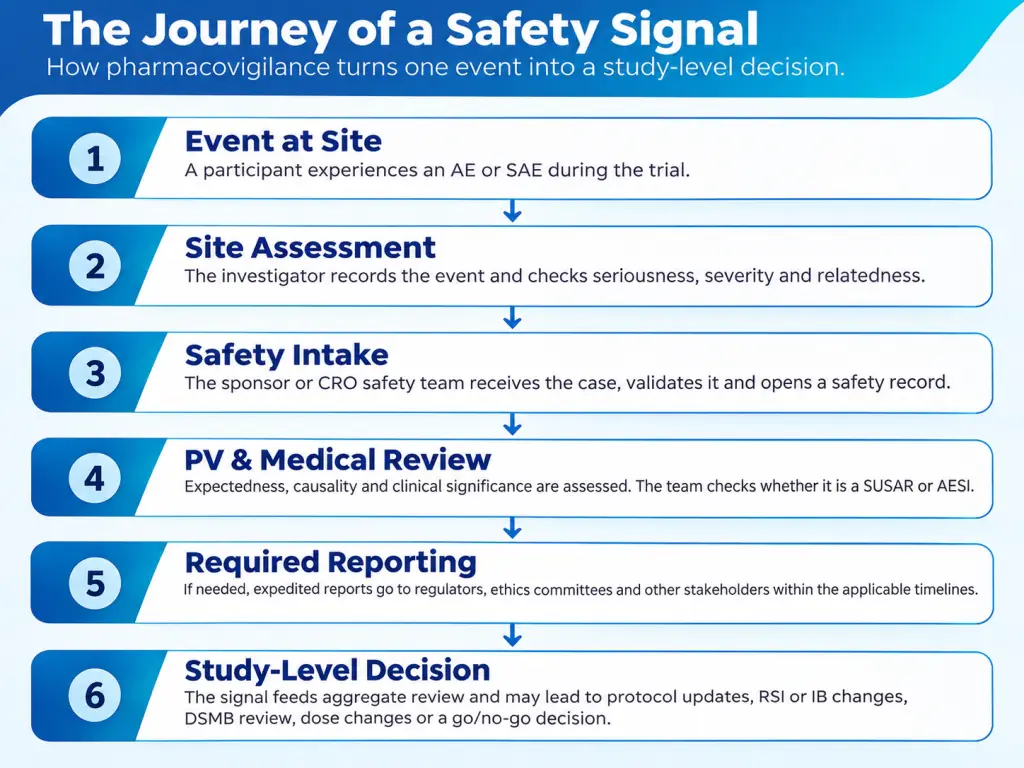
Pharmacovigilance (PV) collects, assesses and reports safety information on an investigational product. In a trial, it is drug safety monitoring with a regulatory clock attached. It decides which events go to regulators, how fast, and what they mean for benefit and risk.
PV is not the same as medical monitoring. A medical monitor reviews individual participants and protocol questions. PV owns case processing, reporting decisions and the cumulative safety picture. Our earlier piece on clinical safety and medical monitoring covers the physician side.
Four terms drive every reporting decision:
| Term | What it means | Who assesses it | What it triggers |
| Adverse event (AE) | Any untoward medical event in a participant, related to the product or not | Investigator | Recorded in the case report form; no expedited report on its own |
| Serious adverse event (SAE) | An AE causing death, a life-threatening state, hospitalisation, disability or a birth defect | Investigator, then sponsor | Prompt report to the sponsor; in India, also to CDSCO and the ethics committee within 24 hours |
| SUSAR (suspected unexpected serious adverse reaction) | A serious reaction, possibly related, not listed in the reference safety information | Sponsor | Expedited report to regulators within 7 or 15 days in the US and EU |
| Adverse event of special interest (AESI) | An event the protocol flags in advance for closer watch | Sponsor, in the protocol | Handled as the protocol specifies, often expedited |
How does Pharmacovigilance Change from Phase I to Phase III?
The safety question changes as exposure grows.
- Phase I asks what dose people tolerate.
- Phase II asks which risks recur in patients.
- Phase III asks whether benefit outweighs risk at scale.
PV shifts from case-by-case review to aggregate analysis along the way. As clinical trial data increases across study phases, statistical analysis becomes important for identifying safety trends, evaluating emerging signals and supporting evidence-based decisions. Clinical biostatistics plays an important role in interpreting these findings.
| Phase | Main safety question | PV focus | Typical outputs |
| Phase I | What dose do participants tolerate? | Real-time review of every AE, dose-limiting toxicity rules, cohort-by-cohort review | Safety review minutes, dose escalation decisions |
| Phase II | Which risks recur in the target population? | Trend review, early signal detection, refining the reference safety information | First annual safety reports, updated investigator’s brochure |
| Phase III | Does benefit outweigh risk in a larger, more varied population? | Aggregate analysis, DSMB support, SAE reconciliation | Annual safety reports, integrated safety summary for the dossier |
| Phase IV | What happens in routine use over longer periods? | Post-marketing surveillance and observational studies | Periodic safety update reports, risk management plan updates |
In early phases, signal detection is mostly clinical judgement. IQVIA’s 2026 framework makes the same point: statistics take a bigger role only as data builds up. This is where pharmacovigilance clinical research differs most from post-marketing safety work.
For first-in-human studies, our guide to common Phase I design mistakes covers dose escalation safety rules in more depth.
What can a Trial not Detect?
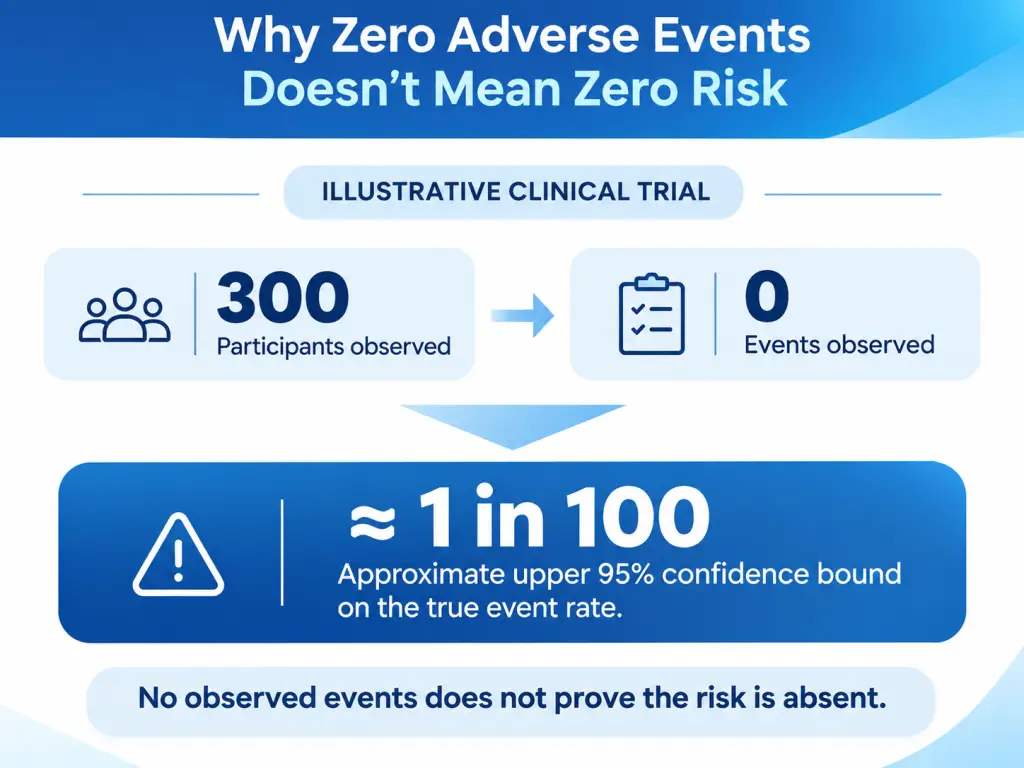
No trial is big enough to see every risk. Take the statistical “rule of three”. Zero events in 300 participants only shows the true rate is probably below 1 in 100.
Rarer reactions usually surface after approval, once far more people use the drug. That is why PV planning has to continue into Phase IV, not stop at submission.
What are the Safety Reporting Timelines in India, the US and the EU?
India sets the tightest clock at site level. Investigators must report every SAE within 24 hours to the sponsor, the ethics committee and CDSCO. The US and EU put their expedited deadlines mainly on sponsors, and mainly on unexpected, related reactions.
| Reporting step | India (NDCT Rules, 2019) | US (21 CFR Part 312) | EU (Regulation 536/2014) |
| Investigator to sponsor | Within 24 hours, also to CDSCO and the ethics committee | Immediately | Within 24 hours of knowledge, unless the protocol says otherwise |
| Analysed SAE report | Investigator within 14 days; sponsor or CRO within 14 days | No separate step | No separate step |
| Fatal or life-threatening SUSAR | Covered by the 24-hour and 14-day reports | 7 calendar days | 7 days |
| Other SUSARs | Covered by the 24-hour and 14-day reports | 15 calendar days | 15 days |
| Ethics committee report to regulator | Within 30 days | No equivalent step | No equivalent step |
| Compensation for trial injury or death | Paid within 30 days of CDSCO’s order, using fixed formulas | No statutory formula | Insurance or indemnity; no fixed formula |
Sources: CDSCO’s SAE reporting checklist and SAE FAQ; US and EU deadlines as summarised by Cloudbyz. Most sponsors also file an annual Development Safety Update Report (DSUR) under ICH E2F.
Two practical points for multi-country trials:
- Clock starts differ: India’s investigator clock runs from the event. Sponsor deadlines generally run from awareness. Record both timestamps on every case.
- One SAE can trigger three different reports: Build a country timeline matrix before first dose, so nobody guesses under pressure.
Our post on regulatory submissions for multi-country trials covers the wider coordination problem.
What Changed for Trial Safety Reporting in 2025 and 2026?
Three changes matter for sponsors running trials in India. The FDA rewrote its safety reporting guidance. ICH E6(R3) became the GCP standard in major markets. And India made CROs directly accountable for their safety duties.
- FDA’s December 2025 guidances: On 16 December 2025, FDA issued final sponsor and investigator guidances, replacing its 2012 and 2009 documents. The sponsor guidance puts more weight on aggregate analysis of anticipated serious events, and less on single-case volume.
- ICH E6(R3):The guideline was finalised on 6 January 2025 and applies in the EU from 23 July 2025. It allows more selective safety reporting in later-stage trials, where participant safety stays protected.
- India’s CRO registration: The NDCT (Amendment) Rules, 2024 took effect on 1 April 2025. CROs now need CDSCO registration and must report SAEs to CDSCO within 14 days. Breaches can lead to rejected trial results or suspension.
One thing we don’t know yet. CDSCO published draft Good Clinical Practice guidelines in September 2024. Check whether a final version applies before you lock your safety plan.
Where do Pharmacovigilance Systems Usually Break?
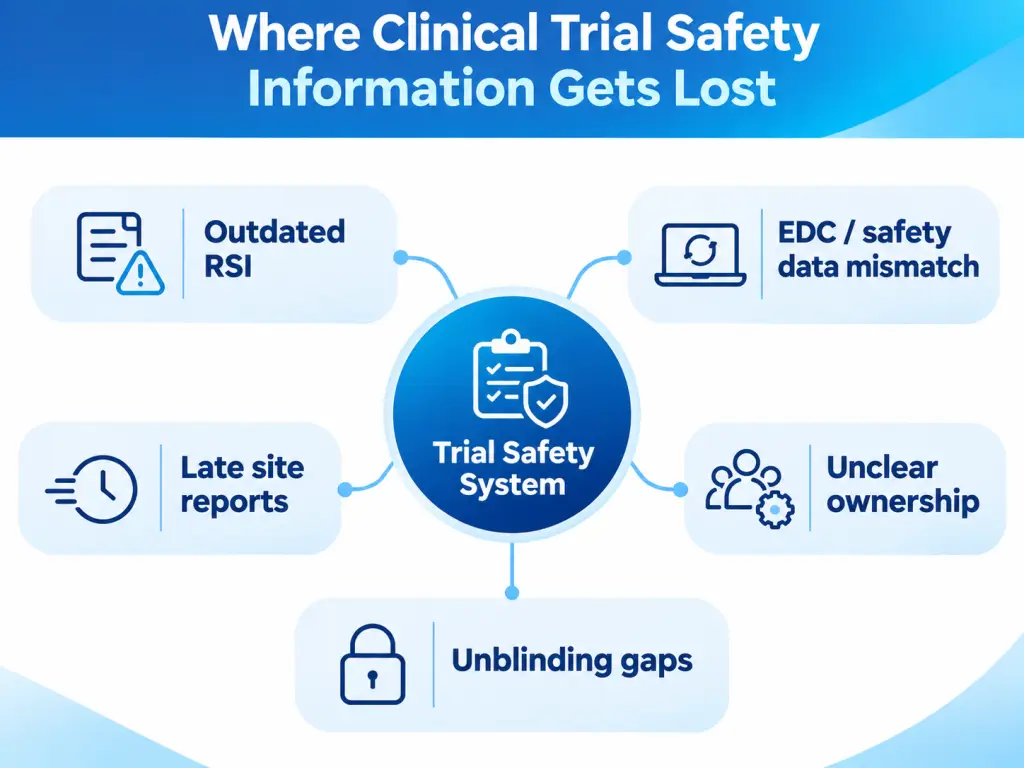
Most PV systems break in process, not medicine. The gaps rarely sit in the science of adverse event monitoring. They sit in the handoffs: reference documents, databases, site reporting and ownership.
- Wrong or outdated reference safety information (RSI). Expectedness is judged against the RSI. If teams use the wrong version, SUSARs get missed or over-reported. The MHRA inspectorate describes this as a common source of findings.
- EDC and safety database out of step. SAE data sits in two systems. SCDM’s standard expects regular reconciliation and a firm cut-off before database lock.
- Late site reports. Track the gap between a site’s awareness date and the date the report reaches the safety team. Review it by site every month.
- Loose unblinding. Some SUSARs must be unblinded for regulators. Name who unblinds, and keep that person out of the study analysis.
- Unclear sponsor and CRO roles. Under ICH E6(R3), the sponsor keeps overall responsibility after handing over tasks. Every safety duty needs a named owner in writing.
How does Strong Pharmacovigilance Improve Development Outcomes?
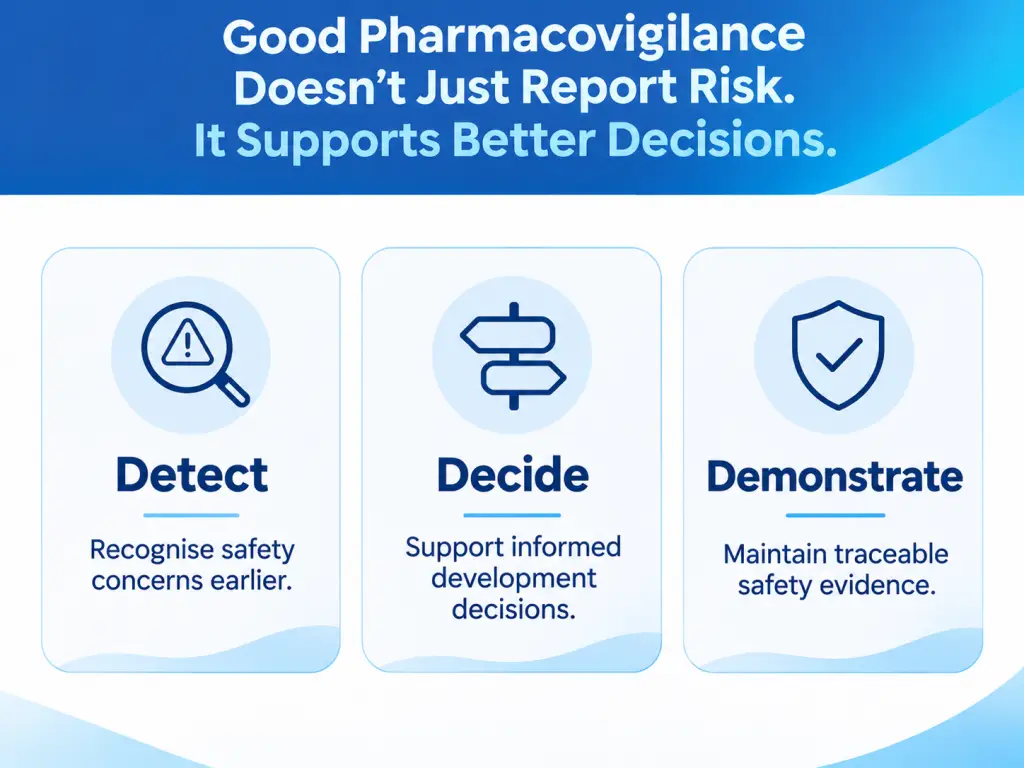
Strong PV turns safety data into decisions. It lets you stop a weak programme sooner, file a cleaner dossier and face inspections calmly. In India, it also limits compensation and ethics exposure.
- Earlier go/no-go calls. A clear signal in Phase II costs far less than a Phase III failure. Given the attrition data above, this is where PV pays for itself.
- Cleaner submissions. Well-kept annual safety reports and reconciled data feed straight into the integrated safety summary.
- Calmer inspections. Traceable case handling lets you show every decision on request.
- Lower exposure in India. Fast, documented causality assessment supports fair compensation decisions under Chapter VI of the NDCT Rules.
- Steadier sites. Investigators keep enrolling when their safety questions get quick, clear answers.
What Should be in Place Before Your First Patient is Dosed?
Set up the safety system before dosing, not after the first SAE. Walk through this checklist with your CRO at kick-off. Don’t open sites until each item has an owner.
- A signed safety management plan with reporting pathways and escalation triggers
- The reference safety information identified, with version control
- A validated safety database with MedDRA coding
- SAE forms built into the EDC, with clear instructions for sites
- A reconciliation schedule between the EDC and the safety database
- A DSMB charter, where the trial’s risk calls for one
- A country timeline matrix covering India, US and EU clocks
- Trial insurance and a compensation process that meets NDCT Chapter VI
- A written split of safety duties between sponsor, CRO and sites
Not every trial needs a DSMB. The level of clinical trial safety monitoring should match the study’s risk, size and design. Document the choice and the reason behind it.
How Innovate Research Supports Pharmacovigilance in Clinical Trials
Innovate Research is an ISO 9001 and ISO 13485 certified clinical research organisation in India. We have completed 250+ studies for 150+ clients across 22+ therapeutic areas. Our pharmacovigilance services cover the full safety cycle of a trial:
- AE, SAE and AESI case processing, causality review and safety narratives
- Physician-led medical monitoring and DSMB support
- SAE submissions to CDSCO and ethics committees within NDCT timelines
- SAE capture and reconciliation in ClinSoft, our in-house EDC, with our clinical data management team
- Aggregate safety analysis through our biostatistics services
- Annual safety reports and narratives from our medical writing team
One limit to be clear about: we cannot take over your legal responsibility as sponsor. We can just make sure every task you hand over has an owner, a deadline and a record.
Write the Safety Plan Before the Protocol is Final
Open your next protocol draft and ask one question. Who reports an SAE, to whom, and by when, in each country? If that answer takes more than a page to find, fix it before the first site opens.
Request a proposal for pharmacovigilance and safety support on your next trial.
FAQs
Is pharmacovigilance only needed after a drug is approved?
No. PV starts with the first human dose. During development, it covers case handling, expedited reporting, annual safety reports and benefit-risk review. After approval, it continues through periodic safety reports and post-marketing surveillance.
Who is responsible for SAE reporting in India: the sponsor, the CRO or the investigator?
All three have duties. The investigator reports within 24 hours and sends an analysed report within 14 days. The sponsor or its registered CRO submits its own analysis within 14 days. The ethics committee then reports to CDSCO within 30 days.
How is compensation decided for trial-related injury or death in India?
The Seventh Schedule of the NDCT Rules sets the formulas. For a death, the amount depends on factors including the participant’s age and a risk factor for the disease. CDSCO issues the order, and the sponsor pays within 30 days.
Does every clinical trial need a DSMB?
No. DSMBs are most common in large, randomised, double-blind Phase III trials and in high-risk studies. Smaller, lower-risk trials can rely on a safety review committee or a medical monitor. Document the choice either way.
What is a DSUR, and when is it due?
A Development Safety Update Report is the annual safety summary for an investigational drug, defined in ICH E2F. It covers all ongoing trials of that drug and follows a fixed annual cycle. For India-specific periodic reports, check the conditions of your CDSCO permission.
What changed in the FDA’s 2025 safety reporting guidance?
In December 2025, FDA split its guidance into separate sponsor and investigator documents. The sponsor guidance stresses aggregate analysis of anticipated serious events over individual case volume. It also gives more flexibility on who reviews aggregate data.