

Your device has passed bench testing. The design is frozen. Then the notified body sends back a long list of questions, and most of them point at one document.
That document is the clinical evaluation report (CER). Under the EU Medical Device Regulation (MDR), it is your proof of safety, performance and clinical benefit. For Class IIb and Class III devices, it is also the file reviewers read hardest.
Many teams still treat the CER as a literature review written once, right before submission. That worked under the old directives. It does not work under the MDR, where the CER is reviewed, updated and challenged for the life of the device.
This guide is for medical device companies in India that sell in the EU or plan to. It covers what a CER must contain and how the requirements change from Class IIa to Class III. Manufacturers preparing for EU market entry can also explore medical device regulatory services for support with classification, technical documentation, clinical evidence and regulatory submissions. It also covers what notified bodies check and what changed in 2026.
What is a CER, and What is it Not?
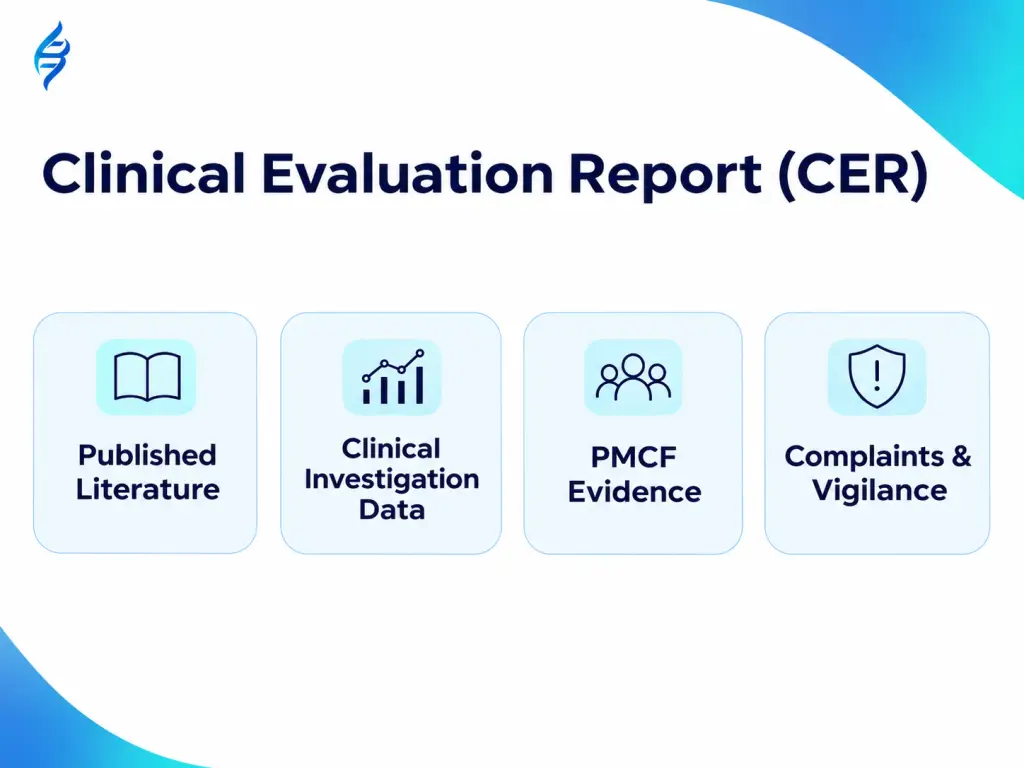
A CER is the written result of your clinical evaluation. It shows, with clinical data, that your device meets the MDR’s general safety and performance requirements when used as intended. Preparing this document requires a structured approach to evidence assessment and regulatory documentation, supported by specialist medical writing services. Article 61 and Annex XIV of the MDR set out the process. Every device class needs one, Class I included.
The CER comes at the end of a planned process. You write a clinical evaluation plan (CEP) first. It defines the intended purpose, target patients, clinical benefits, outcome measures and the benefit-risk criteria you will judge against. Only then do you search for data.
A CER is not:
- A literature review: Published papers are one source. Your own study data, PMCF results and complaint data belong in it too.
- A one-time document: Article 61(11) requires the clinical evaluation to be updated throughout the device’s life.
- A clinical investigation report: That report covers one study. The CER weighs every relevant source, favourable and unfavourable.
- Optional for low-risk devices: What changes with class is the depth of evidence and the review it faces.
How do CER Requirements Differ for Class IIa, IIb and III Devices?
When existing evidence is insufficient, manufacturers may need to plan a new clinical investigation. This involves study design, site feasibility, regulatory and ethics submissions, monitoring and data management. Explore Innovate Research’s clinical trial services in India for support across clinical study planning and execution. Class IIa devices can often rely on literature and equivalence. Class III and implantable devices need a clinical investigation by default and a yearly update cycle. Some also face EU expert panel review.
| Requirement | Class IIa | Class IIb (non-implantable) | Class IIb implantable | Class III |
| New clinical investigation | Only if existing data is not sufficient | Only if existing data is not sufficient | Required by default, unless an exemption applies (Art. 61(4)) | Required by default, unless an exemption applies (Art. 61(4)) |
| Equivalence to another maker’s device | Allowed with enough data access; no contract | Allowed with enough data access; no contract | Contract for full, ongoing access to its technical file (Art. 61(5)) | Contract for full, ongoing access to its technical file (Art. 61(5)) |
| Periodic safety update report (PSUR) | At least every 2 years | At least annually | At least annually | At least annually |
| PMCF evaluation report | Per your PMCF plan | Per your PMCF plan | At least annually | At least annually |
| Summary of safety and clinical performance (SSCP) | Not required | Not required | Required | Required |
| Expert panel review of the CER (Art. 54) | No | Only active devices that give or remove medicines | No | Implantables only |
| Usual CER update cycle | Every 2 years, with the PSUR | Annually, with the PSUR | At least annually | At least annually |
Two caveats on this table. The MDR fixes PSUR, PMCF and SSCP timelines. It sets no CER update interval for Class IIa or non-implantable IIb devices. The cycles shown reflect common notified body practice, so state and justify yours in the CEP. Also, implantable Class IIa devices follow the implantable rules for PMCF and SSCP.
Class IIa: Show that the Evidence is Sufficient
For Class IIa devices, the test is sufficiency. There is no default demand for a new study. Literature, equivalence data, bench results and post-market experience can carry the evaluation if, together, they cover every claim.
The weak point is usually the claims list. A new indication, patient group or performance claim needs its own supporting data. That is the core test for all Class II medical device clinical evidence. Every claim must trace back to data, or it comes out.
Class IIb: Same Logic, Closer Scrutiny
Non-implantable Class IIb devices follow the same sufficiency logic. The difference is review intensity. You file a PSUR at least once a year, and notified bodies expect the CER to keep pace with it.
Two IIb groups face more:
- Implantable Class IIb devices fall under Class III rules for investigations and equivalence, unless listed as well-established technologies.
- Active Class IIb devices that give or remove medicines go through the clinical evaluation consultation procedure (CECP). Infusion pumps are one example. An EU expert panel can then review the notified body’s assessment of your CER.
Class III and Implantables: Plan a Study Unless You can Prove An Exemption
For Class III and implantable devices, Article 61(4) makes a clinical investigation the default, subject to the applicable exemptions. However, the need for a new study depends on the device’s risk classification, intended purpose, available clinical evidence and regulatory pathway. Read our medical device clinical trial requirements by risk class guide to understand how these factors influence clinical investigation decisions across the EU, US and India. MDCG 2023-7 sets out four independent routes out:
- A modification of your own marketed device, where equivalence is shown and the original evaluation was sufficient.
- A legacy device CE marked under the old directives, backed by sufficient clinical data.
- A device type on the well-established technologies (WET) list, such as sutures, screws or plates.
- Equivalence to another maker’s device, with a full-access contract and an MDR-compliant evaluation behind that device.
These devices also carry the heaviest upkeep. The PMCF evaluation report and SSCP must be updated at least annually, and Class III implantables face expert panel consultation. In practice, Class III medical device clinical evidence is a standing programme, not a one-off submission task.
Which “Class II” Needs a CER: EU, US or India?
The CER is an EU MDR document, so “Class II” here means EU Class IIa and IIb. A US Class II device does not need one. India sits closer to the EU model. Its Medical Devices Rules, 2017 define clinical evidence as clinical data plus the clinical evaluation report supporting it.
| Risk level | US FDA | EU MDR | India (CDSCO) |
| Low | Class I | Class I | Class A |
| Low to moderate | Class II | Class IIa | Class B |
| Moderate to high | Class II | Class IIb | Class C |
| High | Class III | Class III | Class D |
The classes do not map one to one, so confirm your class in each market separately. What each regulator expects:
- EU: A CER for every class, reviewed by a notified body for Class IIa and above.
- US: No CER. FDA reviews clinical data inside the 510(k), De Novo or PMA file, and asks for it only where bench and predicate data fall short.
- India: CDSCO’s import licence checklist (Form MD-14) asks for clinical evidence and vigilance data in the Device Master File.
For Indian manufacturers, that overlap is useful. A well-built EU CER can feed the clinical evidence section of your CDSCO dossier, so one evidence base serves both markets.
What are the Four Stages of a Medical Device Clinical Evaluation?
Every evaluation moves through four stages: scope and plan, identify data, appraise data, then analyse and conclude. The CER documents all four. The method comes from the MEDDEV 2.7/1 Rev. 4 guidance, which notified bodies still use alongside the MDR.
- Scope and plan: Define the device, intended purpose, claims, state of the art and acceptance criteria in the CEP.
- Identify data: Run a documented literature search. Gather your own data too: investigations, PMCF, complaints and vigilance.
- Appraise data: Weigh each source for quality and relevance, including data that does not flatter your device.
- Analyse and conclude: Show that benefits outweigh residual risks for every claim. Name the gaps PMCF will close.
Stage 1 decides most outcomes. A vague intended purpose makes every later stage harder to defend. If you fix one thing, fix the intended purpose and claims list before any search runs. This is where specialist medical writing support can help structure the documentation and present the clinical evidence clearly. Where a clinical investigation is required, biostatistics services can support sample-size calculations, statistical planning and analysis.
Can You Rely on Equivalence Instead of a New Study?
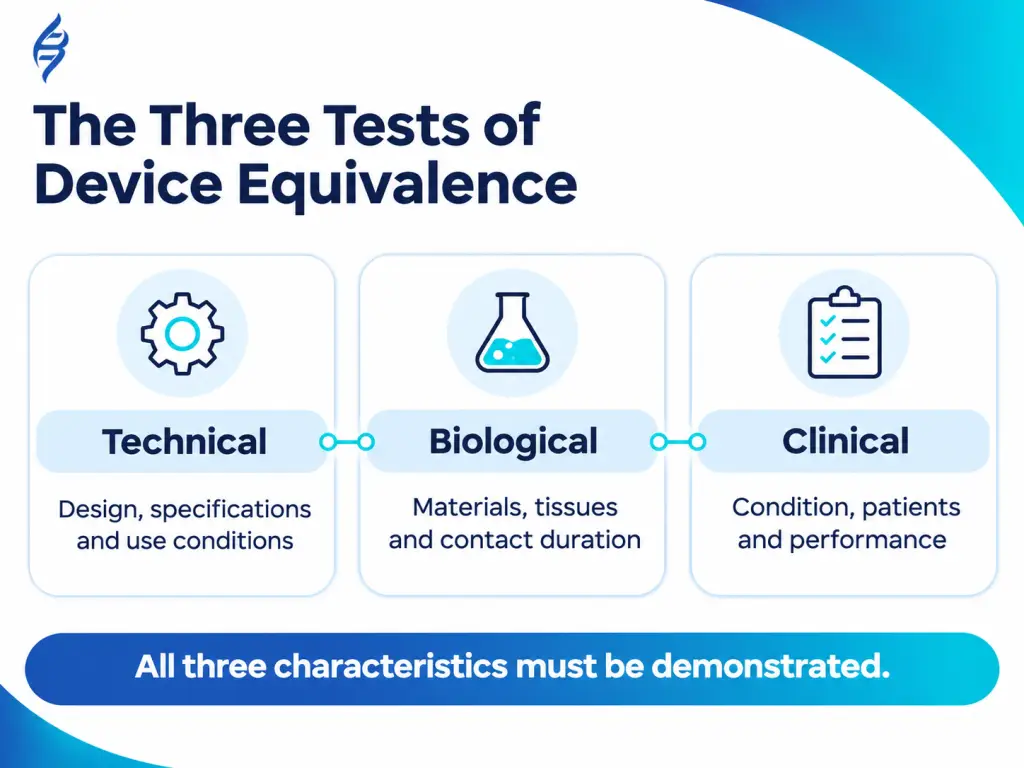
Yes, but for Class III and implantable devices it rarely works with a competitor’s product. You must prove the devices match on technical, biological and clinical characteristics, as MDCG 2020-5 explains. For another maker’s device, you also need a contract giving full, ongoing access to its technical file.
Few manufacturers will hand a competitor their technical file. So for high-risk devices, equivalence usually works only with your own earlier device.
All three characteristics must hold:
- Technical: Similar design, specifications, conditions of use, deployment and principles of operation.
- Biological: The same materials touching the same tissues or body fluids, for a similar kind and length of contact.
- Clinical: The same clinical condition, body site, patient population and user, with similar critical performance.
Similar is not equivalent. A device that looks alike but uses a different material, or treats a different population, fails the test.
For Class IIa and non-implantable IIb devices, no contract is needed. You still need enough access to the other device’s data to prove each characteristic. If your equivalence case is not sufficiently supported, you may need additional clinical evidence or a new investigation. Our guide to whether your medical device needs a clinical trial under EU MDR, FDA and CDSCO requirements explains how risk class and existing evidence influence that decision.
How do You Keep a CER Current After Approval?
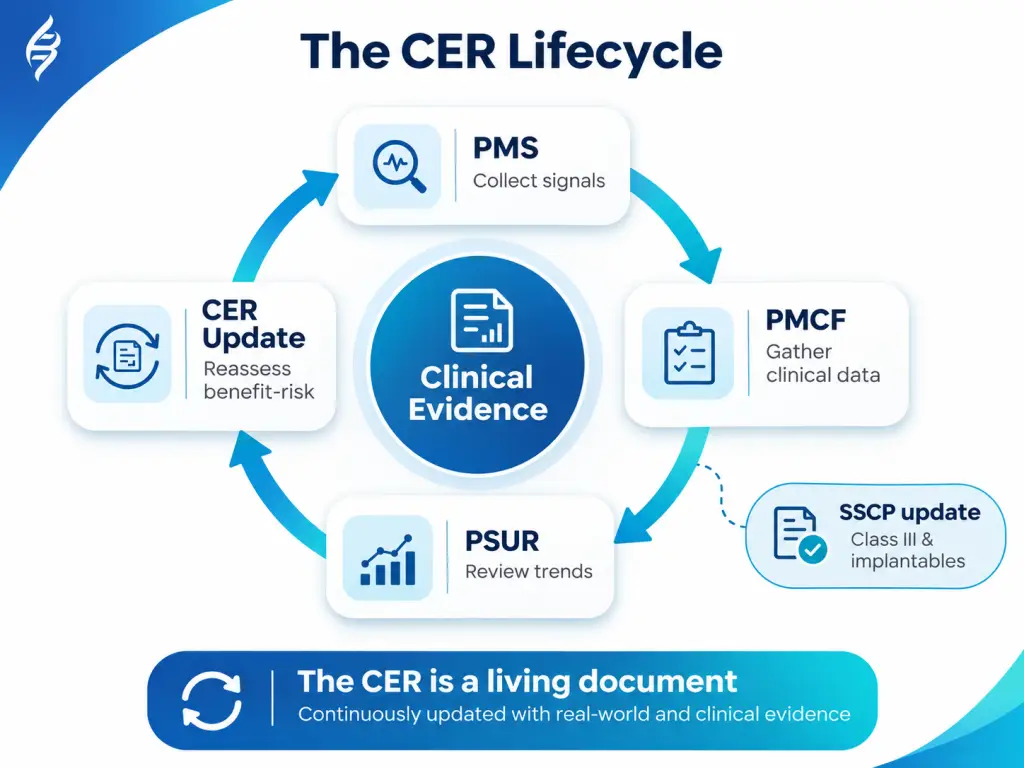
You keep a CER current by feeding it post-market data on a fixed cycle. Surveillance and follow-up generate the data, the PSUR analyses it, and the CER updates its benefit-risk conclusion. A structured post-market surveillance programme for medical devices helps manufacturers collect, assess and act on relevant safety and performance information throughout the device lifecycle. For Class III and implantable devices, this loop runs at least once a year.
The loop works in this order:
- Post-market surveillance (PMS) collects complaints, vigilance reports, trends and new literature.
- Post-market clinical follow-up (PMCF) actively gathers clinical data through studies, registries or user surveys.
- The PSUR analyses what the period’s data means for safety and performance.
- The CER update revises the benefit-risk conclusion and flags new evidence gaps.
- The SSCP update publishes the revised summary for Class III and implantable devices.
Don’t wait for the scheduled cycle if something changes. Update the CER early when:
- A new risk or a trend in serious incidents appears
- You change design, materials or software in a way that affects safety or performance
- You add an indication, patient group or claim
- Your notified body or a competent authority asks for it
Our earlier piece on post-market surveillance for medical devices covers the PMS side in depth. For PMCF data, post-marketing observational studies and real-world evidence programmes are the usual tools.
When Should Manufacturers Update Their Clinical Evaluation Report?
A Clinical Evaluation Report should not be treated as a document that is completed once and then left unchanged. Manufacturers need a defined process to review new clinical information and assess whether it affects the device’s safety, performance or benefit-risk profile.
A CER review may be necessary when:
- New clinical literature becomes available that could affect the existing evaluation.
- New complaints, adverse events or safety signals are identified.
- PMCF activities generate new clinical evidence.
- The device undergoes changes to its design, materials, software or intended purpose.
- New indications, patient populations or clinical claims are introduced.
- Regulatory requirements or notified body feedback require further assessment.
The frequency and scope of updates should be justified according to the device, its risk classification, applicable MDR requirements and the manufacturer’s clinical evaluation process.
For manufacturers that need ongoing evidence generation, post-market surveillance support for medical devices provides further information about maintaining clinical and safety evidence after market entry.
What Changed for CERs in 2026?
Three developments matter. The EU widened the list of devices exempt from mandatory clinical investigations. New rules will make notified body reviews more uniform from February 2027. A broader MDR revision is moving through the European Parliament, but it is not law yet.
| Change | Status | What it means for your CER |
| Expanded WET list, Delegated Regulation (EU) 2026/1451 | In force since 19 July 2026 | More Class III and implantable types, such as cannulas, bone fillers and dental implants, can skip a pre-market investigation. You still need a full CER. |
| Implementing Regulation (EU) 2026/977 | Applies from 25 February 2027 | Uniform procedures and maximum timelines for notified body assessments. A complete, well-indexed CER matters more when every phase runs on a clock. |
| MDR targeted revision, COM(2025) 1023 | Proposal only; Parliament’s plenary vote is expected in early 2027 | Would widen accepted evidence, including non-clinical data, and limit expert panel review to Class III implantables. Today’s rules apply until it is adopted. |
Transition deadlines still stand as well. Under Regulation (EU) 2023/607, qualifying legacy Class III and implantable Class IIb devices need MDR certificates by 31 December 2027. Most other legacy devices have until 31 December 2028.
Our advice: Plan around today’s rules. Treat any relief from the revision as a bonus, not a strategy. The final text could still change, and nobody can say yet by how much.
How Innovate Research Supports CER Work for Device Makers in India
Innovate Research is an ISO 13485 certified clinical research organisation in India that builds and maintains clinical evidence for device makers. We have completed 250+ studies for 150+ clients across 22+ therapeutic areas.
You may need a full CER medical device file built from scratch, or a gap check before recertification. Either way, one team can cover the evidence, writing and submission:
- CEP and CER writing, including literature search and appraisal
- PMCF study design and management, plus registries for long-term safety data
- Sample size and analysis planning through our biostatistics services
- Adverse event and device performance capture in ClinSoft, our in-house EDC
- Regulatory support for EU MDR and CDSCO submissions
Start with Your Claims List, not Your Literature Search
If your CER is due for MDR certification or its next annual update, pull your claims list first. Check each claim against the data behind it. Any claim without data is your biggest risk. It costs far less to fix now than after a deficiency letter.
Request a CER gap assessment from Innovate Research’s regulatory and clinical team.
FAQs
Does a Class I device need a CER?
Yes. Every device class needs a clinical evaluation under Article 61 of the MDR. For most Class I devices, it draws on literature and existing data. Only sterile, measuring or reusable surgical Class I devices involve a notified body, and only for those specific aspects.
How often must a Class III CER be updated?
At least once a year in practice. Under Article 61(11), Class III and implantable devices must update their PMCF evaluation report and SSCP at least annually. The CER draws on both. Update it sooner if new risks, design changes or new claims appear.
Can a Class IIb device claim equivalence to a competitor’s device without a contract?
Yes, if it is not implantable. Article 61(3) applies, and it requires no contract. You still need enough access to the other device’s data to prove technical, biological and clinical equivalence. Implantable IIb devices must use the contract route under Article 61(5).
Do I need a CER for an FDA 510(k)?
No. The CER is an EU MDR document. FDA reviews any clinical data it needs inside the 510(k), De Novo or PMA submission. Much of the same literature and study data can support both markets, but the format and arguments differ.
Does a well-established technology device still need a CER?
Yes. Delegated Regulation (EU) 2026/1451 removes only the duty to run a pre-market clinical investigation. Its recitals state that the clinical evaluation obligation is unchanged. You still plan, conduct and document the evaluation, usually from literature and post-market data.
Who should write the clinical evaluation report medical device teams submit to a notified body?
People with relevant clinical and research experience. MEDDEV 2.7/1 Rev. 4 expects a relevant degree plus five years’ experience, or ten years without a degree. They must declare conflicts of interest, and their CVs go with the CER.