

Most device companies spend years and large budgets getting a product approved. Once the device is on the market, the team moves on to the next launch, and post market surveillance gets whatever time and money are left.
That is a costly mistake. Regulators now treat data from post market surveillance medical devices programs as proof that a product is still safe and still works as claimed. When that proof is weak, it shows up quickly in inspections, audits and certificate renewals.
In this blog, we have explained, what post market surveillance (PMS) really covers, what the US, EU and India require in 2026, what underinvesting costs, and what a well-funded program looks like.
What Post Market Surveillance Actually Covers
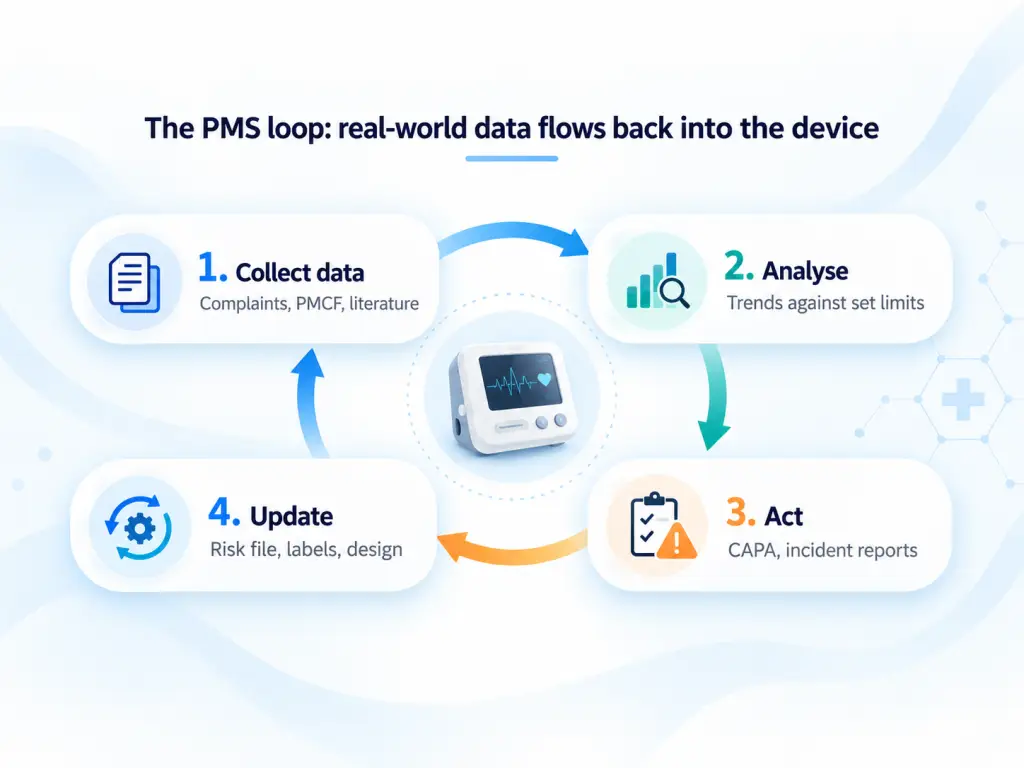
Many teams think PMS just means logging complaints. In reality, medical device post market surveillance is a full system for collecting and acting on real-world data about your device. It includes:
- Complaint handling and investigation
- Reporting serious incidents and adverse events to regulators
- Trend analysis to spot problems early, supported by biostatistics services where statistical analysis is required to identify meaningful safety or performance signals.
- Regular reviews of published literature and similar devices
- Post market clinical follow up (PMCF), registries and other real-world data
The key word is “system”. Data must flow back into risk management, corrective and preventive action (CAPA), labelling and design. If it stops at a spreadsheet, it is not doing its job.
What Regulators Require: US, EU and India
The rules differ by market, but all three now expect an active, documented system.
| Market | Key requirements | What changed in 2026 |
| US (FDA) | Complaint handling, adverse event reporting under 21 CFR Part 803, and studies under Section 522 when FDA orders them | The Quality Management System Regulation took effect on 2 February 2026, aligning US rules with ISO 13485 and bringing a new inspection approach |
| EU (MDR) | Under the EU MDR, a PMS plan for every device, a PMS report for Class I, a periodic safety update report (PSUR) at least every two years for Class IIa and at least yearly for Class IIb and III, plus PMCF | EUDAMED became mandatory on 28 May 2026 for registrations, with the vigilance module still to follow |
| India (MDR 2017) | Mandatory adverse event reporting by licence holders through the Materiovigilance Programme of India | Reports are now filed online through the Indian Pharmacopoeia Commission’s ADRMS system |
India’s reporting culture is still maturing. In one survey of healthcare professionals, only 31% had ever seen the official reporting form. For manufacturers, this means medical device adverse event monitoring cannot rely on hospitals alone. You need your own channels to capture events.
The Real Cost of Underinvesting
Weak PMS rarely fails quietly. It usually shows up in one of these ways:
- Inspection findings: CAPA and complaint handling are consistently among the most cited device problems in FDA’s published inspection observation data. A common pattern is complaints that are logged and closed without investigation.
- Warning letters: Serious or repeated findings can turn into a public warning letter, which damages trust with buyers and partners.
- Certificate delays: In the EU, a thin PSUR or missing PMCF data can lead notified bodies to raise nonconformities and hold up renewals.
- Late recalls: Without trend analysis, a small problem can grow into a field safety action that affects many patients.
- Lost business: Hospitals and tender committees increasingly ask for real-world safety data before they buy.
The cost of a strong PMS program is small compared to any one of these.
What Good PMS Investment Looks Like
Strong medical device PMS is proactive, connected and planned. In practice, that means:
- Active data collection: PMCF studies, registries, user surveys and follow-up calls, not just waiting for complaints to arrive.
- One connected system: Complaints, adverse events, CAPA and risk files are linked, supported by robust clinical data management processes so that safety signals can be captured, reviewed and traced appropriately.
- Clear thresholds: Defined trend limits trigger a review, and every step has a named owner.
- Planned timelines: PMCF results, PSURs and clinical evaluation updates are scheduled to line up, so reports are built from live data, not rushed at the deadline.
- Market-specific procedures: Separate, clear steps for FDA, EU and Indian reporting rules.
Regulators also judge PMS before approval. Medical device regulatory support can help manufacturers integrate post-market and vigilance requirements into the overall regulatory strategy.
The Upside: PMS as a Business Asset
Treated well, PMS pays for itself. Good medical device safety monitoring data can help you:
- Support label expansions and new claims
- Strengthen certificate renewals and clinical evaluation updates
- Give hospitals, payers and tender committees the evidence they ask for
- Catch problems early, before they turn into recalls
- Feed real-world insights into your next product design
In other words, the same data that keeps regulators satisfied can also help you sell.
Best Clinical Research Organisation in India
Innovate Research is an ISO 13485 certified clinical research organisation in India. We have completed more than 250 studies for over 150 clients across 22+ therapeutic areas. For device companies, the team supports the full post market cycle:
- Design and management of post-marketing observational studies and PMCF studies
- Real-world evidence and patient registries for long-term safety and performance data
- Medical writing services for PMS documents, including PSURs, clinical evaluation updates and safety reports.
- Data capture through its in-house EDC platform, ClinSoft, including adverse events and device performance
- Regulatory support for submissions in India and other markets
If you are deciding whether to build this capability in-house, our guide on outsourcing medical device regulatory services explains when a partner makes more sense.
Final Thoughts
Post market surveillance is not a document you write once. It is a continuing system that protects patients, keeps your certificates valid and gives you evidence to grow.
Companies that properly fund their post market surveillance medical devices programs spend less time fixing inspection findings and more time using their data to compete.
Ready to strengthen your PMS program? Talk to Innovate Research about PMCF studies, real-world evidence and PMS documentation support.
FAQs
What is the difference between PMS and vigilance?
Vigilance is one part of PMS. It covers reporting serious incidents and field safety corrective actions to regulators. PMS is the wider system that also includes proactive data collection, trend analysis, literature reviews and feeding results back into risk management.
Do Class I devices need a PSUR in the EU?
No. Class I devices need a PMS report, which is updated when necessary. PSURs apply to Class IIa, IIb and III devices.
When is a PMCF study needed?
The EU MDR expects a PMCF plan for every device. If you decide a new study is not needed, you must clearly justify that decision in your PMS documentation. Studies are usually needed when there are gaps in long-term data, new risks or limited clinical evidence for some patient groups.
What triggers an FDA Section 522 order?
FDA can order a post market study for certain Class II and III devices at any time after clearance or approval. The Section 522 criteria include devices whose failure could cause serious harm, devices with significant use in children, devices implanted for more than a year, and life-sustaining devices used outside a healthcare facility.
How do manufacturers report adverse events in India?
Under the Medical Devices Rules 2017, licence holders must report adverse events to the regulator. Reports go through the Materiovigilance Programme of India, which now uses an online reporting system run by the Indian Pharmacopoeia Commission.
Can we outsource PMS?
You can outsource tasks such as PMCF studies, literature reviews, data management and report writing. However, the manufacturer stays legally responsible for the PMS system, so you need clear oversight of any partner’s work.