

In July 2002, the US Women’s Health Initiative stopped its estrogen plus progestin trial about three years early. The trial had enrolled 16,608 women. Its data safety monitoring board had found that health risks exceeded the benefits, and its recommendation was unanimous.
That call protected thousands of women. It worked because the board, its stopping rules and its data flow were set up long before anyone needed them.
This guide is for sponsors running trials in India, alone or as part of a global programme. It covers when you need a DSMB and what India, the US and the EU expect. It ends with a 12-week plan to get one running before first patient in. Sponsors planning a new clinical trial should also consider how safety oversight will work throughout the study. Explore our guide to clinical safety and medical monitoring in clinical research to understand how medical monitoring and safety committees support participant protection.
What is a DSMB, and What does it Actually Decide?
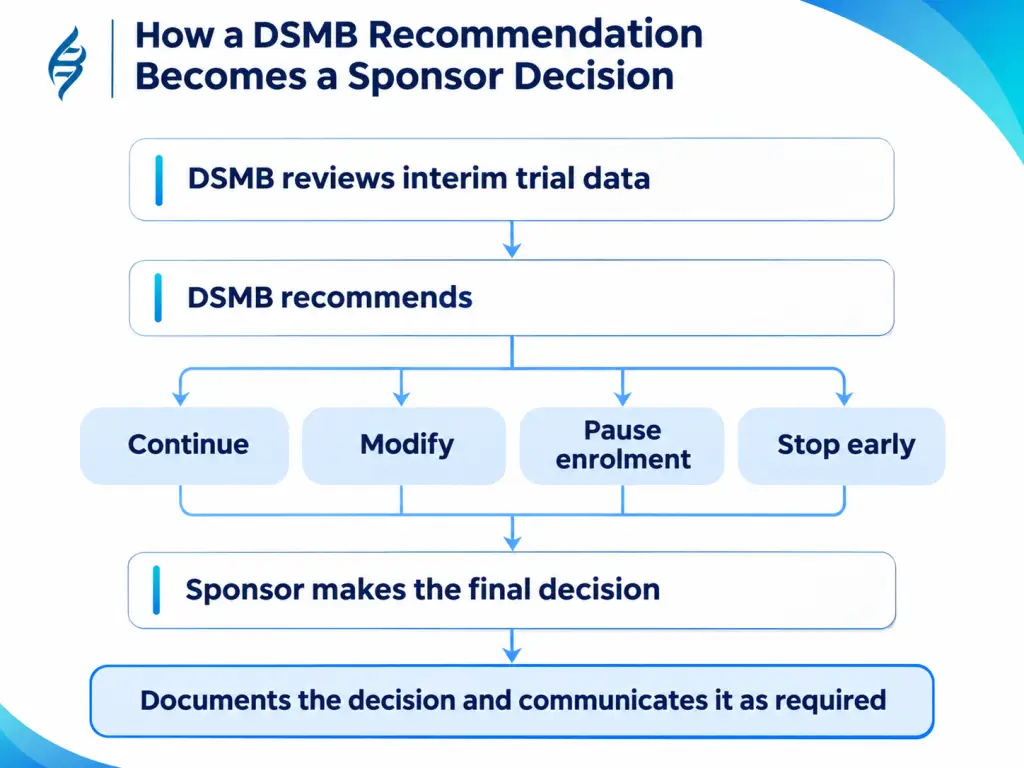
A DSMB is an independent group of experts who review unblinded interim data while a trial runs. Regulators also call it a data monitoring committee (DMC). It recommends whether the trial should continue, change or stop. It does not make the final decision; the sponsor does.
A DSMB can recommend that a trial:
- Continues as planned
- Continues with changes, such as a dose change or tighter eligibility
- Pauses enrolment while a safety question is checked
- Stops early for harm, overwhelming benefit or futility
The EMA’s Q&A on DMCs is clear on who decides. Recommendations are not binding, and a DMC cannot stop a trial itself. If you reject a recommendation to stop or substantially change a trial, tell the ethics committee and the regulator.
A DSMB is one part of the safety system, not all of it. Our guide to pharmacovigilance in clinical development explains the wider safety reporting and case-handling processes that operate alongside independent board reviews.
Does Your Trial Need a DSMB, or Will a Lighter Option do?
Most trials don’t need a full DSMB. A DSMB in clinical trials makes sense when the risk is high or the trial is long and blinded. It also fits when interim analyses could end the trial early. Smaller, lower-risk studies can use a safety review committee or a single independent safety monitor.
| Option | Best fit | Who sits on it | Sees unblinded data? |
| Full DSMB | Large blinded Phase III trials, mortality or major morbidity endpoints, vulnerable groups, planned interim efficacy analyses | Independent clinicians, a biostatistician, sometimes an ethicist | Yes, in closed sessions |
| Safety review committee | Phase I dose escalation and early Phase II studies | Sponsor and investigator physicians, often with one independent expert | Depends on the design |
| Independent safety monitor | Small, lower-risk single-site studies | One independent physician | As needed for individual cases |
Set up a full DSMB if any of these apply:
- The primary endpoint involves death or serious, irreversible harm.
- Participants are children, pregnant women or otherwise vulnerable.
- The product is novel, with limited human safety data.
- The protocol plans interim analyses for efficacy or futility.
- The trial is large, blinded and runs for a year or more.
What do Regulators Expect in India, the US and the EU?
None of the three requires a DSMB for every trial. India’s NDCT Rules don’t name one specifically, and the US mandates one only for emergency research without consent. The EU leaves it to risk. Ethics committees and regulators can still expect one for higher-risk studies.
| Market | Is a DSMB required? | Main guidance | What sponsors should know |
| India | No specific requirement in the NDCT Rules, 2019 | ICMR’s 2017 National Ethical Guidelines list a DSMB as one monitoring option | Ethics committees can ask for one, especially in research involving children. In multicentre trials, one DSMB usually covers all sites. |
| US | Only for emergency research without informed consent | FDA’s 2006 final guidance; a 2024 draft is not yet final | FDA may ask to see the charter, ideally before the trial starts. |
| EU | Not mandatory for all trials; expected where risk is high | EMA guideline on DMCs, plus a 2020 Q&A | Sponsors must justify and report any decision not to follow a recommendation to stop. |
Sources: JIPMER’s DSMB guidance on the ICMR and NDCT position, ICMR’s paediatric guidelines, Morgan Lewis on the FDA position, and PSI on charter timing.
A note on the US rules. FDA’s February 2024 draft guidance would replace the 2006 version. As of November 2026 it is still a draft, so the 2006 guidance remains in force. The draft is still worth reading, because it shows where FDA thinking is heading.
For trials in India, the gap in formal rules is a reason for more care, not less. Treat the DSMB as part of your clinical trial oversight plan, and record why you chose it or a lighter option. The THSTI clinical trial toolkit offers an Indian charter template to start from.
Who Should Sit on Your DSMB?
A typical DSMB has three to five independent members. You need clinicians who know the disease and a biostatistician who understands interim analysis, statistical methodology and the interpretation of emerging trial data. Sponsors can explore clinical biostatistics services for support with statistical planning, randomisation, blinding and interim analysis. None of them should have a stake in the trial, the product or the sponsor.
- Clinicians: A 2026 best-practice editorial recommends at least three voting physicians, so the board can reach a clear majority.
- A biostatistician: Pick someone experienced in sequential and interim analysis, not only general trial statistics.
- An ethicist or patient voice: Add one when participants are children, pregnant women or otherwise vulnerable.
- An experienced chair: The chair runs closed sessions and signs off recommendations.
Experience is scarcer than most sponsors expect. An expert panel in Clinical Trials found most DMC members had no formal training. It suggests pairing a new member with an experienced one.
Keep independence strict. Exclude trial investigators, sponsor staff and anyone with a financial or professional interest in the outcome. Collect written conflict declarations at appointment and confirm them at every meeting.
In India, some specialties have a small pool of experienced, independent experts. Start recruiting early. For global trials, a mix of Indian and international members can widen the pool.
What must the DSMB Charter Cover?
A well-structured charter should clearly document the board’s responsibilities, review procedures, communication process and decision-making framework. Sponsors preparing the supporting clinical documentation can also explore medical writing services for clinical research. PSI advises keeping it short: guiding principles, not a second protocol.
Cover at least these points:
- Scope and authority: what the board reviews and what it can recommend
- Membership, voting rights and quorum
- The conflict-of-interest process
- Meeting schedule and the triggers for an unscheduled meeting
- Open and closed sessions, and who may attend each
- Data flow: what is sent, in what format and how soon after cut-off
- Stopping guidelines for harm, efficacy and futility, agreed with your statistician
- How recommendations reach the sponsor, and how fast
- Confidentiality rules for members and the independent statistician
- How the charter itself gets amended
Have every member and the sponsor sign it before the first patient is dosed.
How do You Keep the Sponsor Away from Unblinded Data?
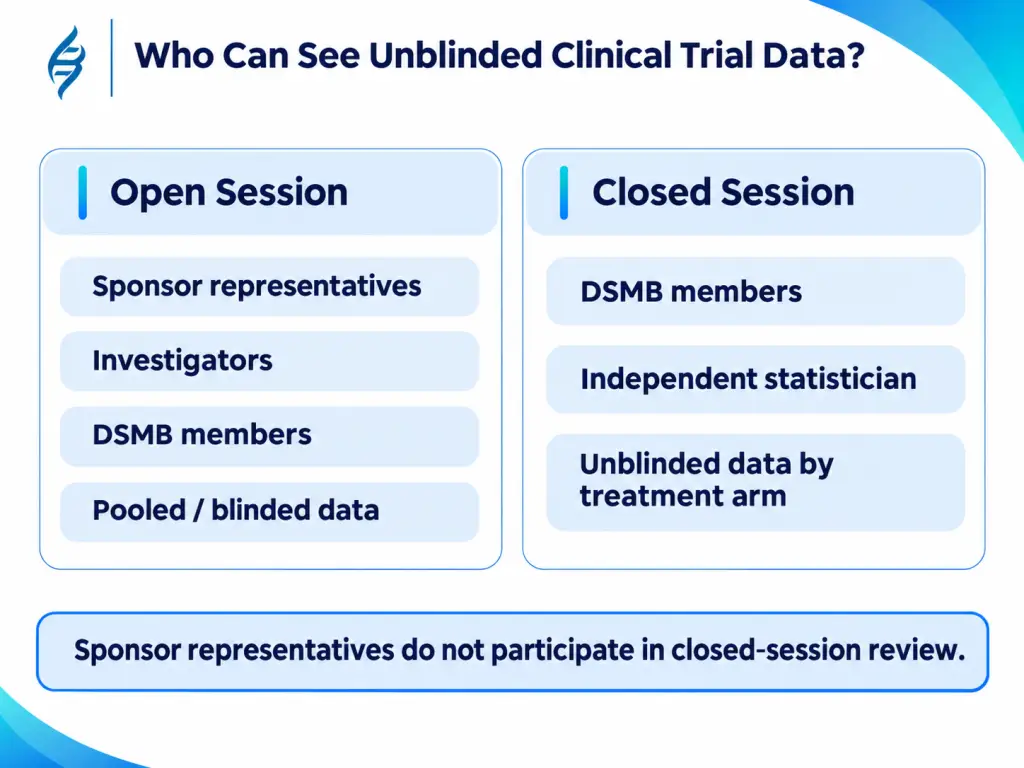
Use an independent statistician who sits outside your study team. That person prepares two reports for each review. The open report shows pooled data; the closed report shows data by arm. Only DSMB members and the independent statistician see the closed report. Appropriate interim statistical analysis support helps ensure that the reports are prepared using the methods and procedures agreed in the charter. The open report shows pooled data; the closed report shows data by arm. Only DSMB members and the independent statistician see the closed report.
- Open session: Sponsor and investigator representatives can attend. Discussion covers recruitment, data quality and pooled safety data.
- Closed session: Only members and the independent statistician attend. This is where data by arm is reviewed and recommendations are formed.
- Fast data delivery: The same 2026 editorial gives a delivery target of about seven days after data cut-off. Agree yours in the charter.
Why does this matter? If interim trends leak, investigators may enrol or treat patients differently. That bias can damage a trial’s credibility in ways no later analysis can repair.
What does a 12-Week DSMB Set-up Plan Look Like?
Plan for about 12 weeks between deciding you need a DSMB and dosing the first patient. Recruiting members and agreeing stopping guidelines usually take longest. This is our recommended plan, not a regulatory rule.
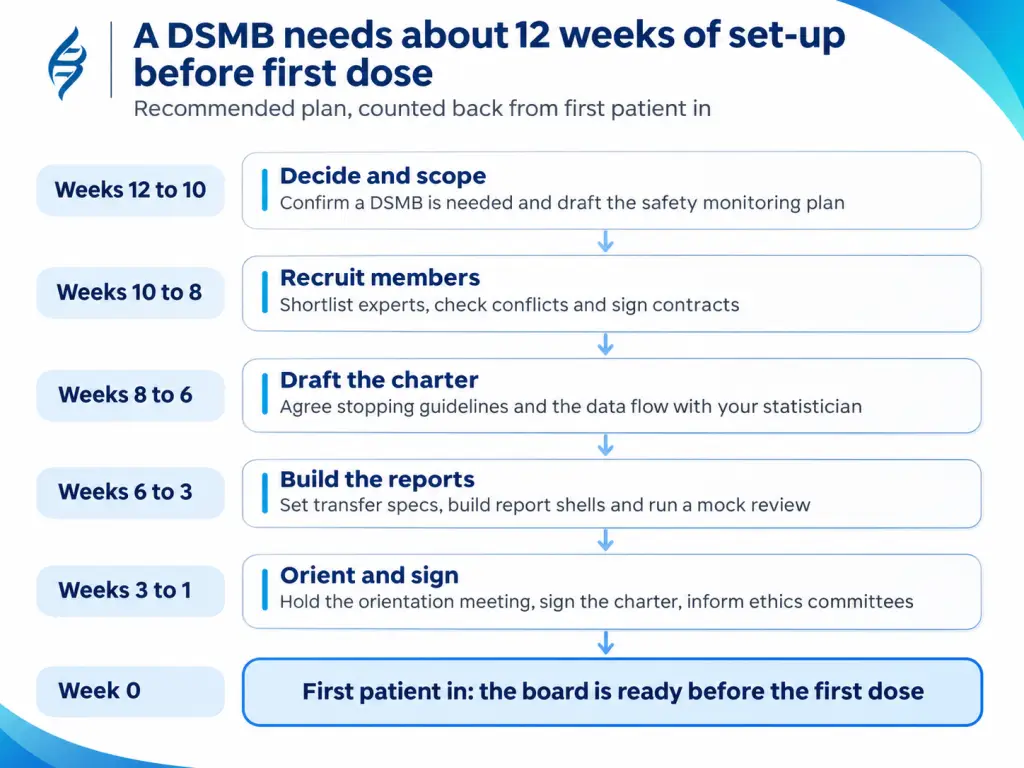
Each stage feeds the next, so a slip in member recruitment pushes the whole plan back. If members are already lined up from an earlier trial, you can compress the first two stages.
The first data review then follows the trigger set in the charter. That is usually a set number of enrolled patients or a set time after first dose.
Where do DSMBs go Wrong?
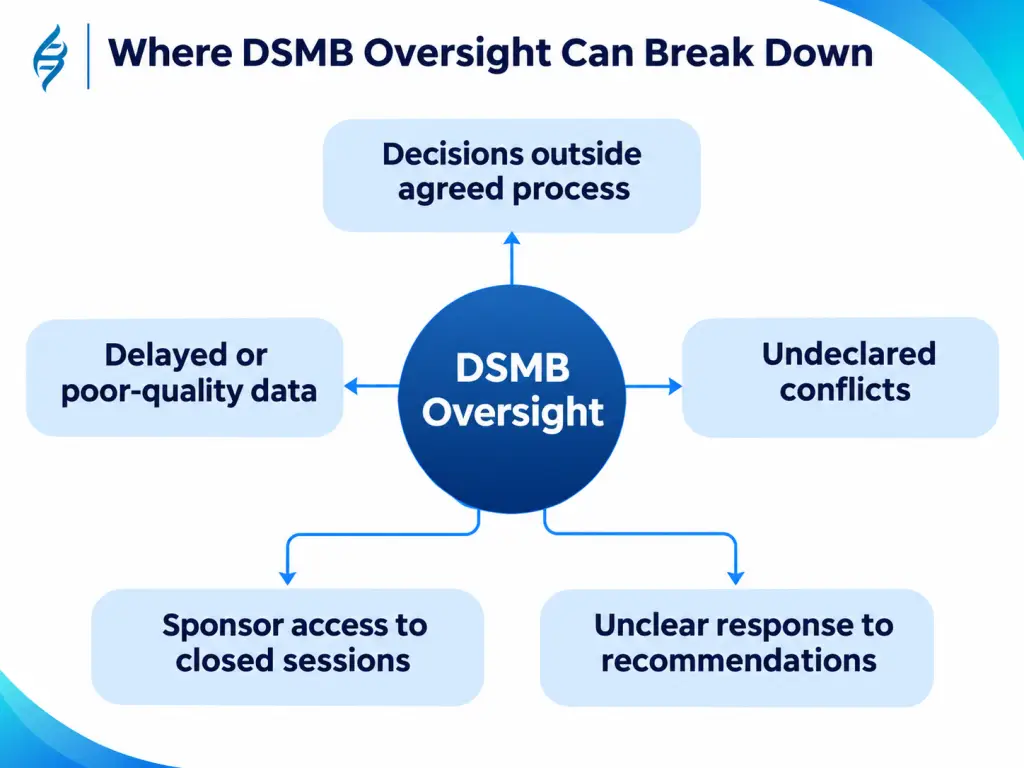
DSMBs rarely fail on medicine. They fail on process: stop decisions taken outside the board, slow data, hidden conflicts and charters nobody can follow.
The ADAPT Alzheimer’s prevention trial shows the cost. Officials stopped the trial without a scheduled DSMB review recommending it. A later commentary judged that, as a result, the trial’s findings could not be reliably interpreted.
Watch for these failure points:
- Stop decisions made outside the board’s agreed process
- Data that arrives late or unclean, so reviews run on stale numbers
- Members with undeclared links to the sponsor or a competitor
- Sponsor staff sitting in closed sessions
- Charters so long that nobody follows them
- No plan for how the sponsor will act on a recommendation
Is a DSMB Worth the Cost?
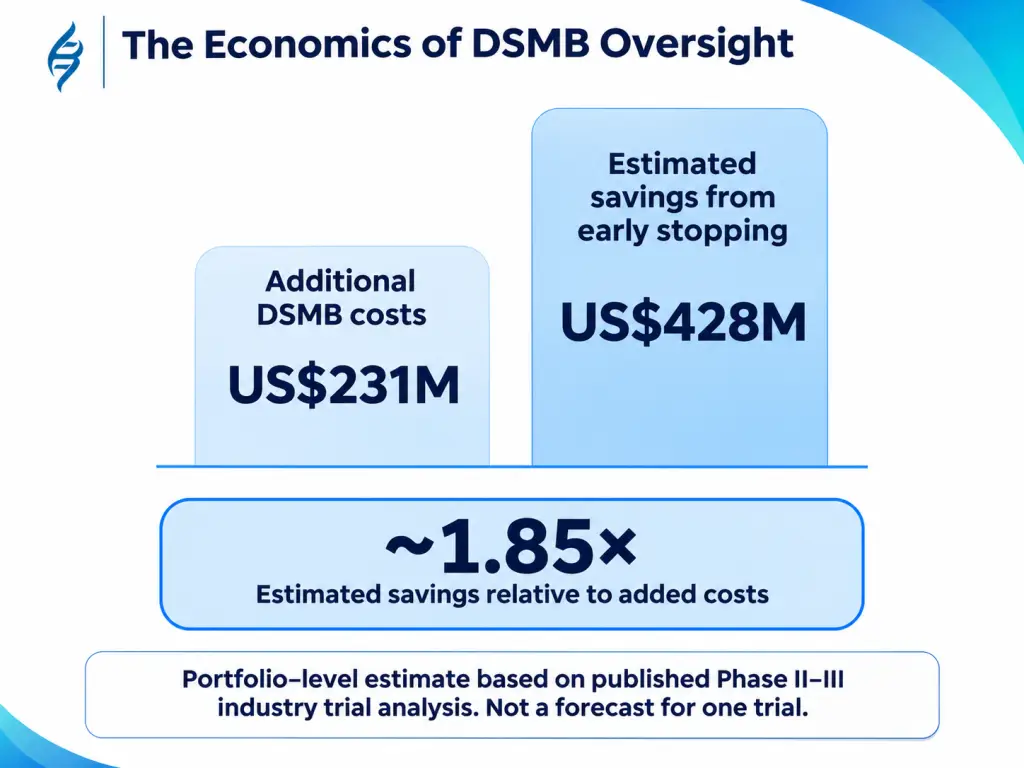
The best published estimate says yes. A model in Therapeutic Innovation & Regulatory Science studied the extra DMCs added to industry Phase II and III trials from 2007 to 2013. It put their added cost at about US$231 million, against about US$428 million saved through early stopping.
The same study found DMC use rising fast. Mentions of DMCs in industry trials in high-impact journals rose from 24% to 47%.
Treat this as a portfolio-level estimate, not a promise for one trial. A single DSMB may never stop anything, and that is still a good outcome.
Where the money goes:
- Member fees, usually paid per meeting or per hour at fair-market rates
- The independent statistician and the programming behind each report
- Meeting management, minutes and document archiving
- Sponsor and CRO time to clean and transfer data before each review
We haven’t listed fee ranges here, because they vary widely by specialty, region and trial size. Cytel’s guidance on cost drivers is a useful starting point for budgeting.
How Innovate Research Helps Sponsors Run a DSMB
Innovate Research is an ISO 9001 and ISO 13485 certified clinical research organisation in India. We have completed 250+ studies for 150+ clients across 22+ therapeutic areas. Our safety team can help you set up a data safety monitoring board and run it through close-out:
- Choosing between a DSMB, a safety review committee or an independent safety monitor
- Charter drafting and stopping guidelines with our biostatistics team
- Identifying independent members and managing conflict declarations
- Independent statistician support and open and closed report programming
- Data transfers from ClinSoft, our in-house EDC, with our clinical data management team
- Meeting coordination, minutes and communication with ethics committees in India
Our physician-led medical monitoring team works alongside the board between reviews. Our earlier piece on clinical safety oversight explains how the two roles fit together.
One limit to be clear about: we don’t sit on your DSMB. Its members must stay independent of both the sponsor and the CRO that supports it.
Sign the Charter Before You Open Your First Site
Open your protocol and find the line that says who reviews unblinded safety data, and when. If that answer isn’t settled and signed, settle it before the first site opens.
Request a proposal for DSMB set-up and safety support on your next trial.
FAQs
Can the sponsor attend DSMB meetings?
Yes, but only the open session. Sponsor staff can update the board on recruitment, data quality and trial conduct. Closed sessions, where data by arm is reviewed, are limited to members and the independent statistician.
What happens if the sponsor disagrees with a DSMB recommendation?
The sponsor makes the final call, because a DSMB only recommends. Under EMA guidance, a sponsor rejecting a recommendation to stop or substantially change a trial should document why. It should also tell the ethics committee and the regulator.
How often should a DSMB meet?
There is no fixed rule. Meetings usually follow enrolment milestones, event counts or set time intervals written into the charter. Plan an early review after the first patients are dosed, and allow unscheduled meetings for urgent safety issues.
Who pays DSMB members, and does that affect independence?
The sponsor usually pays members at fair-market rates for their time. Payment alone does not break independence. Problems start when members hold other financial or professional ties to the sponsor, so declare and review every conflict.
Can one DSMB oversee several trials?
Yes. One board can monitor several trials of the same product or in the same disease area. That helps it spot signals across studies. The charter must state which trials it covers and how each trial’s data is reported.
Is a DSMB the same as an ethics committee?
No. An ethics committee approves the protocol and protects participants’ rights at its sites. A DSMB reviews accumulating trial data, often unblinded, across all sites. In multicentre trials, many ethics committees may rely on one DSMB.