

A Phase 1 trial costs about US$7,829 a day to run, according to Tufts CSDD. That covers only the trial itself. It leaves out the months of runway a small biotech burns while waiting to start.
Most early programmes don’t slip because of technical reasons. They slip because of planning gaps. Toxicology waits for drug supply, the dossier waits for toxicology, and sites wait for everyone.
This guide shows biotech companies how to build a realistic preclinical to Phase 1 timeline on a limited budget. It covers typical durations, where time is lost and the India route. It also covers real costs and the 2026 shift away from animal testing. If your team is new to trial phases, start with our plain-English guide to Phase I to Phase IV.
How Long does it take to get from Candidate to First Dose?
Most programmes need 18 to 36 months from candidate selection to IND submission, according to Charles River. Regulatory review and site start-up come on top. Modality, indication and drug supply decide where you land in that range.
A typical clinical trial development timeline for a small molecule breaks down like this:
| Stage | What happens | Typical time | Main cost drivers |
| IND-enabling studies | GLP toxicology, safety pharmacology, pharmacokinetics | Part of the 18 to 36 months before submission | Species, study length, test material supply |
| Manufacturing (CMC) | Drug substance, formulation, GMP clinical batch, stability | Runs in parallel with toxicology | CDMO fees, analytical methods, stability work |
| Regulatory submission | Protocol, investigator’s brochure, dossier, review | FDA: 30 days. CDSCO: 30 or 90 working days | Medical writing, regulatory strategy |
| Phase 1 conduct | Dosing, safety review, pharmacokinetic analysis | Several months, depending on cohorts and dose levels | Site and participant costs, bioanalysis |
For what happens after you file, see our guide to regulatory submission timelines at each milestone.
What are Primary Causes of Delay in Clinical Development?
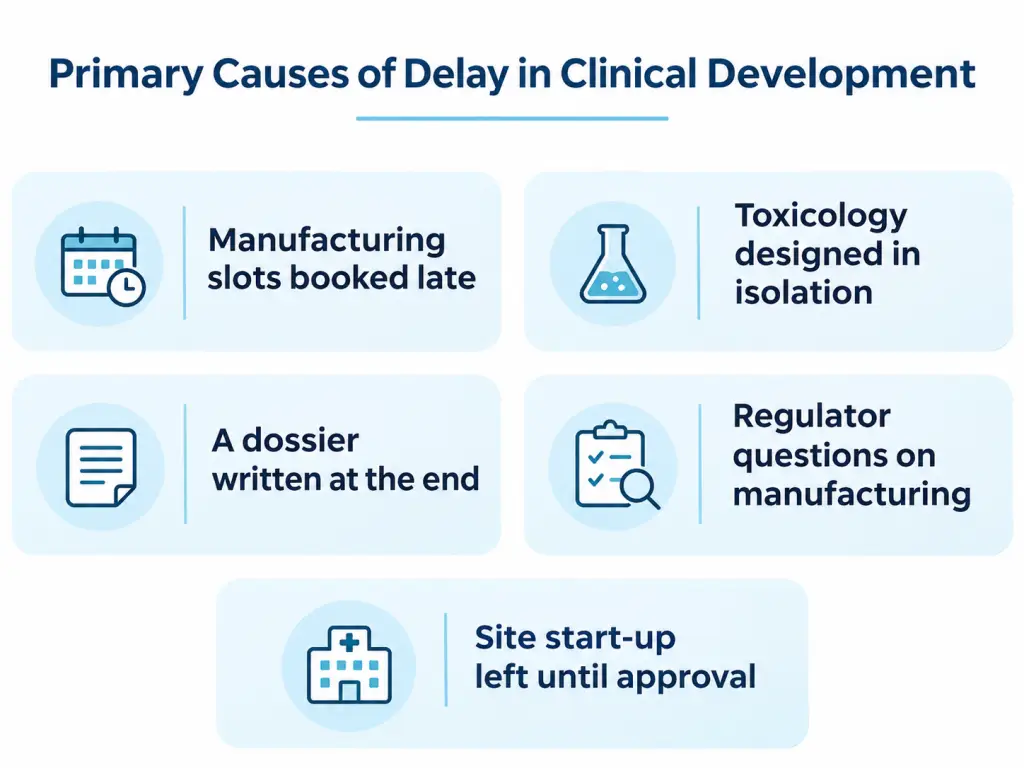
Time is lost at handoffs, not inside single studies. In biotech clinical development, the slowest workstream sets the first-dose date, and manufacturing is often that workstream. Toxicology can’t start without test material, and the dossier can’t close without both.
The primary causes:
- Manufacturing slots booked late: Good CDMOs book GMP capacity months ahead. Ask for a provisional slot before the formulation is final.
- Toxicology designed in isolation: If animal studies don’t match the planned dose, route or formulation, they may need repeating.
- A dossier written at the end: Write the nonclinical and CMC sections as data comes in, not in one sprint after the last result. Preparing regulatory documents alongside study progress can reduce last-minute documentation pressure. Explore our clinical and regulatory medical writing services for protocol, investigator’s brochure and clinical study report preparation.
- Regulator questions on manufacturing: Gaps in CMC data often trigger review questions, and each round adds weeks. Early regulatory planning can help sponsors identify submission requirements and documentation gaps through clinical trial regulatory support before filing.
- Site start-up left until approval: Contracts, ethics review and site selection can run alongside the regulatory review.
One project lead who owns every workstream catches these handoff gaps early. Our guide to project management in clinical trials explains how. Sponsors can also explore our clinical trial project management services for coordination of study activities, timelines, budgets and operational deliverables.
What does the India Route look like Compared with the US?
India can be faster for drugs discovered or developed in India. CDSCO must respond to those applications within 30 working days, or the trial is deemed approved. Drugs discovered elsewhere face a 90-working-day clock and usually need Phase 1 data from abroad first.
| Step | India (NDCT Rules, 2019) | US (FDA IND) |
| First-in-human allowed? | Yes, for drugs discovered or developed in India. Others submit Phase 1 data from abroad first. | Yes, once the IND is in effect |
| Review clock | 30 working days for India-developed drugs; 90 working days for others | 30 calendar days after the IND is received |
| If the regulator stays silent | Deemed approval; you must inform CDSCO before starting | The trial may begin unless FDA places a clinical hold |
| Ethics review | Approval from a registered ethics committee | Approval from an institutional review board |
| Trial registration | CTRI registration before the first participant enrols | Most Phase 1 trials fall outside the US registration mandate |
Source: CDSCO’s FAQ on the NDCT Rules, 2025.
Phase 1 clinical trial planning in India starts with one question: Where was the drug discovered and developed? For an Indian biotech, the 30-working-day route is a real advantage. For a foreign sponsor, India usually fits after first-in-human data exist elsewhere. Sponsors planning early-phase studies can explore Phase I clinical trial services in India, including study feasibility, site selection, regulatory coordination and clinical trial management.
Our guide to navigating CDSCO approvals covers the application step by step.
What does it Actually Cost to Reach Phase 1?
A US government-funded analysis put the average US Phase 1 study at $1.4million to $6.6 million. The range depends on therapeutic area. That excludes IND-enabling studies and manufacturing. India-specific costs are not well published, so treat any single number with caution.
Where the money goes before and during Phase 1:
- Toxicology and safety studies under GLP, plus the test material they need
- Manufacturing: Drug substance, formulation, GMP batch and stability testing
- Regulatory and medical writing: Protocol, investigator’s brochure and dossier
- Phase 1 conduct: The unit, participants, bioanalysis and monitoring
- Contingency for a repeated study or a regulator query
For Indian biotechs, non-dilutive funding can cover part of the gap. BIRAC grants, such as the Biotechnology Ignition Grant, can fund early proof-of-concept work before you raise larger rounds.
How do You Plan Backwards from First Dose on a Limited Budget?
Set a target first-dose date, then work backwards through each workstream. A clinical development timeline built this way shows which tasks must overlap and when each tranche of money is needed.
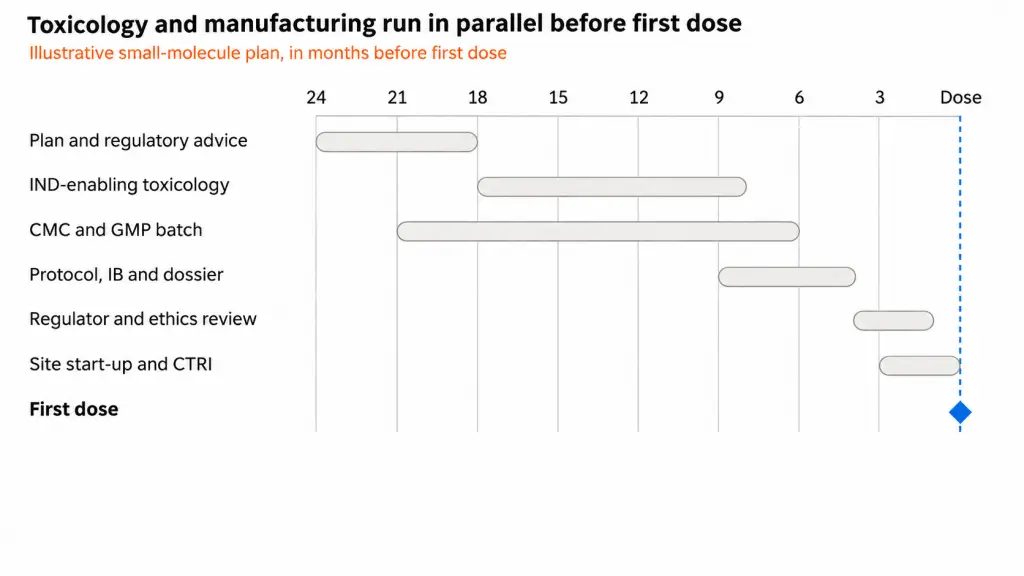
The plan above is illustrative, not a benchmark. It reaches IND submission at about 20 months and first dose at 24, within the 18 to 36 month range. Manufacturing starts first, because toxicology needs test material, and the two then run side by side. Your own durations should come from vendor quotes, not from this chart.
Five budget moves protect that plan:
- Fund to the next decision, not the whole plan: Release money stage by stage, against clear go/no-go criteria.
- Design toxicology around the planned trial: Match dose, route and formulation so studies don’t need repeating. Our guide to first-in-human study design covers the clinical side.
- Reserve a manufacturing slot early: Book a provisional GMP slot before the formulation is final.
- Ask the regulator before you spend: A pre-submission meeting can stop you running studies you don’t need.
- Use fewer vendors: Each extra contractor adds handoffs, contracts and delay. Our checklist for choosing a CRO partner in India helps you compare options.
Before you file, check that you have:
- A target product profile and a written development plan
- A toxicology plan matched to the draft protocol
- A GMP batch and stability plan with dates
- Draft protocol and investigator’s brochure
- An ethics committee and CTRI plan, plus a site shortlist
How are Non-Animal Methods Changing Preclinical Plans?
The FDA now encourages non-animal data in IND packages. Its April 2025 roadmap plans to reduce, refine or replace animal testing, starting with monoclonal antibodies. For some antibody programmes, this could shorten the preclinical development timeline and cut primate study costs.
What has happened so far:
- December 2025: Draft guidance let some antibody programmes shorten or drop primate toxicology studies.
- March 2026: FDA issued draft guidance on how new approach methods should be validated.
- April 2026: FDA reported meeting its first-year goals.
- May 2026: FDA issued draft guidance on streamlined nonclinical safety studies for oncology biologics and conjugated products.
- September 2026: FDA issued a direct final rule confirming that non-animal methods can be used, where appropriate, to test the safety of drugs and biologics.
For most small molecules, standard animal toxicology still applies today. Acceptance of non-animal data is case by case, so agree your approach in a pre-submission meeting first.
India has moved more slowly. A 2023 amendment to the NDCT Rules lets sponsors use non-animal methods, such as cell-based assays, organ chips and computer models, alongside animal studies. In practice, CDSCO still commonly expects standard animal toxicology, so agree any reduced package with CDSCO before you rely on it. If you plan to file in both countries, design for the stricter of the two.
Set the First-Dose Date, then Fund Backwards to Each Gate
A realistic preclinical to Phase 1 timeline starts from the date you want to dose, not the date toxicology starts. Work back from that date and find the overlaps. Then release money only when the last gate is passed.
Innovate Research is an ISO 9001 and ISO 13485 certified clinical research organisation in India. We have completed 250+ studies across 22+ therapeutic areas, including Phase I studies on IND molecules. For early-phase programmes, we support:
- Regulatory strategy and CDSCO applications through our regulatory support team
- Protocol and investigator’s brochure writing by our medical writing team
- Study feasibility and site selection
- Sample size and analysis planning through our biostatistics team
- Data capture in ClinSoft, our in-house EDC
One limit to be clear about: we don’t run toxicology studies or GMP manufacturing. We help you plan the clinical, regulatory and data work around them. Our clinical trial biostatistics services also support sample size calculations, randomisation, statistical analysis plans and clinical study reporting.
Request a proposal to plan your path to first dose.
FAQs
How long does it take to go from preclinical studies to Phase 1?
Most programmes need 18 to 36 months from candidate selection to IND submission. Regulatory review and site start-up add a few more months. Biologics, cell and gene therapies, and novel mechanisms usually sit at the longer end.
Can a drug discovered outside India start its first-in-human trial in India?
Generally, no. CDSCO’s FAQ says sponsors of drugs discovered abroad must submit Phase 1 data from outside India first. CDSCO may then allow a repeat Phase 1 or move straight to Phase 2.
What is deemed approval under India’s NDCT Rules?
If CDSCO doesn’t respond within the set clock, the application is treated as approved. The clock is 30 working days for drugs developed in India and 90 working days for others. You must inform CDSCO before starting the trial.
How much does a Phase 1 trial cost?
A US government-funded analysis put the average US Phase 1 study at US1.4milliontoUS6.6 million. Tufts CSDD puts the daily running cost at about US$7,829. Published India-specific figures are scarce.
Can non-animal data replace toxicology studies today?
Only partly, and case by case. In the US, the clearest progress is for monoclonal antibodies. India’s rules have allowed non-animal methods since 2023, but standard animal toxicology is still the norm in practice. Agree any reduced animal package with the regulator before you rely on it.
When should a biotech bring in a CRO?
Before the protocol is final, ideally while you write the development plan. Early input on regulatory strategy and trial design avoids repeat studies. Our piece on why biotechs need a regulatory-savvy CRO early explains why.