

If you’re planning a clinical trial in India, you’ve probably already heard the pitch: lower costs, a massive patient pool, and a growing regulatory infrastructure. It’s all true. But here’s what doesn’t get talked about enough: Your outsourcing model matters just as much as where you run the trial.
Choose the wrong model, and you can undo every advantage India gives you. The two primary model options are
- Full-Service CRO
- Functional Service Provider (FSP)
The model will suit very different kinds of sponsors, trials, and internal capabilities. Getting this decision right early saves months of rework and a significant budget.
In this guide, we will break down both models provided by CROs in India in the context of India’s unique clinical trial environment, so you can make a confident, informed call.
Why Does India Change the Equation for CRO Model Selection?
India isn’t just another affordable emerging market for clinical trials. It’s a genuinely different operating environment, and that difference matters when you’re choosing how to structure your outsourcing. India’s CRO outsourcing market is growing at a projected CAGR of 12% over the next five years
On the upside, you get a:
- Large and genetically diverse patient population,
- Cost-effective operations
- Growing pool of experienced clinical professionals.
The Indian government has also been actively streamlining regulatory processes, with CDSCO implementing reforms that are cutting approval timelines considerably.
On the other hand, conditions vary significantly across states. Site quality, CRA availability, and infrastructure are strong in metros like Mumbai, Hyderabad, and Bangalore, and far more variable in Tier 2 and 3 cities.
This on-the-ground variability is one of the most important factors shaping which model performs better, and it’s something sponsors new to India often underestimate.
Bottom Line:
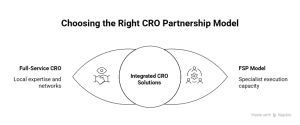
What Are the Two Models and What Makes Them Different?
62.2% of CRO engagements globally were full-service in 2024 — though FSP is rapidly gaining ground
What is a Full-Service CRO?
A Full-Service CRO takes complete, end-to-end ownership of your clinical trial, including:
- Protocol development
- Site selection
- Patient recruitment
- Clinical monitoring
- Data management
- Final regulatory submission
How It Works
- All services are handled under one roof
- Uses the CRO’s own systems, SOPs, and infrastructure
- Ensures a standardized and streamlined execution process
Key Advantage: Accountability
- Single point of contact
- One unified set of processes
- One partner fully responsible for delivery
Why It Matters
- Reduces handoffs between multiple vendors
- Simplifies communication and coordination
- Minimises delays and operational complexity
Best Suited For
- Sponsors without a large internal clinical operations team
- Companies looking for a turnkey, fully managed solution
What is the FSP Model?
The Functional Service Provider (FSP) model focuses on outsourcing specific functions rather than the entire trial, such as:
- Clinical monitoring
- Data management
- Biostatistics
- Pharmacovigilance
- Medical writing
How It Works
- You retain strategic and operational control of the trial
- FSP staff work as embedded members of your team
They operate using:
- Your SOPs
- Your EDC and CTMS platforms
- Your timelines and priorities
Key Advantage: Control & Flexibility
- You remain the central coordinator
- FSP provides specialized expertise and execution support
- Enables better alignment with your internal processes
Why It Matters
- Access to skilled talent without long-term hiring
- Flexible scaling based on project needs
- Greater control over decision-making and execution
How to Think About It
- Not traditional outsourcing
- More like extending your internal team with external expertise
- Scales capabilities without adding overhead
Is There a Third Way? The Hybrid Model
Yes, and it’s increasingly common. Hybrid models combine elements of both: full-service delivery for core trial operations (say, site management and monitoring), paired with FSP arrangements for specific functions where the sponsor has strong internal capability or wants to maintain direct control (say, biostatistics or regulatory affairs).
Hybrid approaches are worth considering seriously, but they do add coordination complexity. The more interfaces you introduce, the more governance discipline you need.
Full-Service CRO vs FSP vs Hybrid: Side-by-Side
Here’s how the three models compare across the dimensions that matter most to pharma and biotech sponsors operating in India:
| Dimension | Full-Service CRO | FSP Model | Hybrid |
| Accountability | Single CRO owns everything | Shared: sponsor leads, FSP executes | Split by function |
| Sponsor Control | Low. Best CROs in India uses own SOPs | High. Sponsor SOPs & systems | Medium |
| Cost Structure | Milestone-based (bundled) | FTE-based (transparent) | Mixed |
| Best For | First-time India sponsors | Multi-trial portfolios | Capability gap sponsors |
| Site Activation | Faster via CRO networks | Depends on sponsor’s site relationships | Variable |
| Data Ownership | CRO systems (limited visibility) | Sponsor retains full data ownership | Partially retained |
| Scalability | Moderate | High | High |
How Do the Two Models Compare Across What Matters Most?
1. Which Model Gives Sponsors More Control Over Their Trial?
If data visibility and operational control are priorities for your team, the FSP model has a clear edge. FSP teams work within your platforms and processes, meaning you see everything in real time, and nothing gets locked inside a vendor’s proprietary system.
Full-service CROs, by contrast, tend to operate within their own infrastructure. This works well when you trust the partner and don’t need granular day-to-day visibility.
2. Which Model Is More Cost-Efficient for Clinical Trials in India?
Both models can deliver strong ROI in India, but the cost structure works differently.
Full-service CROs use milestone-based pricing. Costs are bundled into predefined deliverables. It’s easier to set a top-line budget upfront, but it can be harder to understand exactly where your money is going.
FSP engagements are typically FTE-based. You pay for defined roles and hours. Scope and pricing are agreed upfront, making budget planning more predictable and cost management more granular.
For sponsors running multiple trials in India, this transparency compounds into meaningful savings over time.
3. Which Model Activates Trial Sites Faster in India?
Site activation speed is one of India’s biggest selling points globally and which model you choose affects whether you can actually capture that advantage.
For sponsors new to India, a full-service CRO with an established site network typically activates faster. They have existing relationships with principal investigators, know which sites perform well in which therapeutic areas, and can navigate CDSCO timelines with local experience.
4. Which Model Navigates India’s Regulatory Environment Better?
India’s regulatory landscape has improved considerably. The New Drugs and Clinical Trials (NDCT) Rules 2019 and CDSCO’s ongoing streamlining of approval timelines have made India a more attractive regulatory destination. But it still requires specific expertise to navigate well.
Full-service CROs carry this expertise in-house, which is a real advantage for sponsors conducting their first India trial. Regulatory affairs, CDSCO submissions, ethics committee management are all handled by people who do this every day in the Indian context.
FSP allows you to bring in that regulatory expertise as a specific function, without ceding control of your overall submission strategy. If you already have a strong regulatory lead internally, FSP gives you execution support without unnecessary duplication.
5. Which Model Scales Better Across a Multi-Trial Portfolio?
This is where FSP has a decisive advantage. If you’re planning multiple trials in India over several years, building FSP relationships creates compounding efficiency — teams are already embedded in your systems and processes, onboarding gets faster, and consistency improves across studies.
It’s telling that the shift among large biopharma companies toward in-house capabilities operationalized through FSP models is considered a genuine paradigm shift in the industry — not a temporary trend. For sponsors with a growing India pipeline, this trajectory is worth building toward from the start.
Which Model Is Right for Your Trial? A Decision Framework for Sponsors
There’s no universal right answer. The best model depends on your internal capabilities, your trial scope, and your long-term India strategy. Use this framework as a starting point:
| Sponsor Profile | Recommendation | Key Reason |
| First-time India sponsor, single Phase II/III trial | Full-Service CRO | No local infrastructure; needs end-to-end guidance from day one |
| Global pharma with in-house PM & multiple India trials | FSP Model | Control, cost efficiency, and compounding scalability across studies |
| Biotech with strong internal biometrics but weak field ops | Hybrid | Outsource monitoring; retain data management and SOP control |
| Sponsor with data standardization concerns across vendors | FSP Model | Use own EDC system; FSP executes under a single set of standards |
| Early-phase trial needing speed and local site access | Full-Service CRO | Established site networks and regulatory speed in India |
What Are the Risks of Each Model and How Do You Mitigate Them?
What Can Go Wrong with a Full-Service CRO Engagement in India?
- Data visibility gaps: If you’re not actively managing the relationship, it’s easy to lose real-time insight into trial progress and data quality.
- Vendor lock-in: Switching mid-trial is costly and disruptive. Do thorough due diligence upfront, not just on capabilities, but on the CRO’s track record in your specific therapeutic area in India.
- SOP inflexibility: Full-service CROs operate within their own frameworks. If your internal standards differ significantly, alignment can create friction.
What Are the Hidden Challenges of Running an FSP Model in India?
You need robust in-house clinical operations capability. FSP assumes you can lead project management, regulatory strategy, and cross-functional integration. Many mid-size biotech’s entering India underestimates this requirement.
CRA availability in Tier 2 and 3 cities remains a bottleneck. India’s experienced CRA talent is concentrated in metros. FSP sponsors need a clear plan for field coverage in non-metro sites.
Governance discipline is non-negotiable. Multiple FSP providers across different functions means more coordination overhead. Without a tight governance framework, integration breaks down quickly.
The Bottom Line: Which Model Should You Choose?
There’s no single right answer and be cautious of anyone who tells you otherwise. The right model is the one that fits your internal capabilities, your trial scope, and where you are in your India journey.
If India is new territory for you, choose Full-Service CRO
If you already have clinical ops capabilities in-house and you’re building a multi-trial India pipeline, the FSP model offers more control
Looking for a clinical research organization in India?
Contact Innovate Research. We have an experienced team of experts who specialize in clinical research, data management, medical writing and more. We are also well versed with frameworks and compliances from around the world including the FDA and EMA. Visit Innovate Research to learn more about our services.
Frequently Asked Questions
1) What is the core difference between a Full-Service CRO and an FSP model in India?
A Full-Service CRO manages your entire trial end-to-end using their own systems, SOPs, and team, giving you a single point of accountability. An FSP model outsources specific trial functions (monitoring, data management, etc.) to specialists who work within your systems and follow your processes.
2) Which model is more cost-effective for clinical trials in India?
It depends on your trial volume and internal capabilities. For a single trial, full-service can be easier to budget upfront. For sponsors running multiple India trials, the FTE-based pricing of FSP delivers greater transparency and compounding cost efficiency.
3) Can you switch from a Full-Service CRO to an FSP model mid-trial in India?
It’s possible but disruptive and expensive. Switching mid-trial requires migrating data, transferring site relationships, and realigning SOPs, all while the trial is live. It’s far better to make the right call before trial initiation.
4) Which model works better for Phase I vs Phase III trials in India?
Phase I trials often benefit from full-service CROs, given the need for tightly controlled environments and specialized safety monitoring infrastructure. Phase III registrational trials, which require large patient numbers across multiple sites, can go either way: full-service for sponsors new to India’s site landscape; FSP or hybrid for sponsors with established site networks and in-house clinical ops.
5) Are hybrid CRO-FSP arrangements available in India?
Yes, and they’re increasingly common. Hybrid models allow sponsors to use a full-service CRO for core operational functions (site management, monitoring) while bringing in FSP specialists for biometrics, data management, or regulatory affairs.